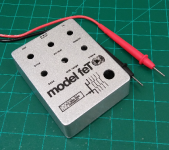
Thoughts on EAE's jab at the Mofeta Schem?

I enjoyed the irony of someone pointing out that the illustrative picture of Marlon Brando from the Godfather was probably used without permission. Except, of course, that there may be some laws protecting how the Godfather image could be used in a media post unlike selling a PCB that recreates a traced circuit.

Also sort of interesting to see some quibbling about the layout not adequately separating the charge pump from the analog signal path since placement is not usually the issue with noisy charge pumps.

I understand that small businesses selling pedals would prefer that clone PCBs of their pedals not be sold. But in many cases those pedals are just one-offs of other designs, and it is hard to argue that swapping out a diode or two or retuning the frequency for a tone control is enough to protect that particular design from further modding. And supplying PCBs for in-demand pedals certainly enables that competition. But I doubt if the volume of cloned pedals that are sold really makes a dent in the actual sales of the retail pedal.

I have never seen brew pubs complain about other brew pubs copying their flavor profiles for the different beers they sell.
 
I can say that I hadn't heard of probably 3/4 of the pedal manufacturers I've been introduced to since discovering this as a hobby, for whatever that is worth. I also hadn't bought an effects pedal in a decade with the exception of a Behringer which is a commercially available $40 knock off of the BDDI, which is a $200+ pedal that is still manufactured. Getting upset/agitated with one-offs making PCBs and the few people selling on Reverb from there seems a little silly to me when there is literally en entire city in China dedicated to copying musical technology, but then again you can't go to Uli's Facebook page and argue with him directly, so whaddyagonnado, I guess.

Actually, I wonder if being copied by Behringer might be like Weird Al covering one of your songs - you've finally made it to the big leagues!

Are rando sellers on Reverb and eBay cutting in to small builder's business? Is there a metric by which that can be measured? Is that really the problem, or do builders just feel it is disrespectful to use the things that they have developed? And then if that's the issue you then have to get in to detangling what exactly is *new* about what has been done, and is it really new? It all seems to be one big, tangled mess. These are honest questions, not intended to suggest anything in particular, just thoughts I've had.
 
The more interesting question to me is what EDQ thinks about folks improving their designs, since that is unmistakably the case with at least one pedal here. I doubt if anyone here would feel bad to see EQD revising a board down the road that looked similar to anything done here.

In comparison, I think Devi Ever was willing to just stick a bunch of parts more or less randomly together to find some cataclysmic sounds that suits her fancy. And I don't recall "Ever" seeing any complaints from her about people rolling their own versions of her pedals.
 
I had a response to this in the "wish list" thread and was expecting some dialogue, but it got deleted. I'll quote it below so I don't have to re-iterate my thoughts. I'm not as bothered now but I do always appreciate the opportunity to set the record straight.

TL;DR: I have strong qualms about the layout and there are some inaccurate cap values. ¯\_(ツ)_/¯

Hey, John from EAE here. About a month ago I heard a Model feT copy was in the works here. I hoped I could simply joke about it and move on, but I’m still feeling bothered. There isn’t really a playbook for how to handle this stuff.

I obviously don’t own the Model T design (just as Sunn didn’t own the 5F6) and I certainly wasn’t the first person to use JFETs in lieu of tubes. I’ve never claimed otherwise, in fact I directly credit Runoffgroove in the product manual. I think the calling card of the Model feT is the power amp emulation circuit. At the time I initially designed it (c. 2015-2016) I believed the approach to be novel, at least in a pedal context. I have since more accurately identified it as a case of convergent emulation (e.g. Intersound IVP, a couple things floating around DIY Stompboxes), so I’m not the only person who realized a transistor differential amplifier sounds good when overdriven. Now, I did start with the ROG approach in a sense, but their model does not do a good job of emulating 1) triode miller capacitance and 2) partial frequency bypass of a common cathode amplifier. So I gradually worked around these things through many hours of simulations and comparisons with the original Model T. That’s the whole story.

Anyway first, BOM errors: while the build doc isn’t up yet, the component list was posted in a separate thread that was brought to my attention. There are a few capacitor values that aren’t present on our BOM, hence my comment that the parts were inaccurate. If the discrepancies are what I think they are, and my back-of-the-envelope math checks out, the mofeta is going to sound significantly brighter than the Model feT. Worst case scenario it could be unstable at high gain, particularly with drive pedals stacked in front. Something to look out for should you build one.

Second, layout issues: applying high speed layout techniques to analog circuitry produces diminishing returns. But, at any speed, it’s good to keep high impedance nodes as short as possible, and you should keep sensitive amplifiers away from any clocks or SMPS/charge pump circuitry. JFET gates are extremely high impedance—so high that we have to specify an IPC-A-610 Class 3 cleaning step (read: maximally clean) on our boards because stray capacitance from excess flux can measurably change the frequency response.

So why did I call the mofeta layout bad? The component placement alone throws up serious red flags. The “preamp” JFETs are located all the way near the bottom, but their respective gain controls at the top. On top of that, the charge pump (IC100) is 1) close to the gain pots and 2) smack dab in the middle of both halves of the simulated phase inverter. I can’t see how this wouldn’t throw KHz switching spikes all over the place, or possibly heterodyne with other charge pumps and digital (FV1/BBD) clocks in your signal chain. I’ve debugged these issues for myself and others multiple times in the past. That kind of noise is a dealbreaker.

I’ve reverse engineered pedals before—old, forgotten treasures with no schematics to be found. Reverse engineering is a LOT of work. So I really have to wonder, why spend all that time copying in-production pedals when you could put that energy toward designing something new instead? I don’t get it.

Thanks for letting me speak my peace. If anybody wants to talk about this directly my email inbox is always open.

 
I assume we're talking about a 470pF, 680pF, and 2.2nF?

I have two units here side by side, in one of them those three values are unquestionably 100pF, 220pF, 220pF (respectively).

I'm not arguing what is spec'd on the original schematic or BOM, I'm just reporting what was actually installed. This doesn't appear to be a hand assembled board, maybe the pick and place was having a bad day?
 
I had a response to this in the "wish list" thread and was expecting some dialogue, but it got deleted. I'll quote it below so I don't have to re-iterate my thoughts. I'm not as bothered now but I do always appreciate the opportunity to set the record straight.

TL;DR: I have strong qualms about the layout and there are some inaccurate cap values. ¯\_(ツ)_/¯
So if you clone something, All the components should be in the same position.
I need to contact all the YATS builders out there & let them know!
 
One of the commenters voiced the question "I don't get why clones of pedals currently in production exist?" Ignoring the fact that maybe you just want to build a Tube Screamer just to see how it works, there is a larger fact that it's extremely hard to get your hands on something from Electronic Audio Experiments. Don't get me wrong, John's stuff is incredible, but he's a one man production company and can basically only make a run of a single kind of pedal at once. He announces it, it gets sold out within hours, and then it's back to waiting to see what might get released next. Sometimes people might want to build their own and have it working in far less time than it would be to wait for a chance to get the real thing.
 
I had a response to this in the "wish list" thread and was expecting some dialogue, but it got deleted. I'll quote it below so I don't have to re-iterate my thoughts. I'm not as bothered now but I do always appreciate the opportunity to set the record straight.

TL;DR: I have strong qualms about the layout and there are some inaccurate cap values. ¯\_(ツ)_/¯
Really fascinating comments. I'll have to run this by a friend of mine because I'm not experienced enough to understand some of the minutiae. 😝 I do think I absorb the larger point though.
 
I assume we're talking about a 470pF, 680pF, and 2.2nF?

I have two units here side by side, in one of them those three values are unquestionably 100pF, 220pF, 220pF (respectively).

I'm not arguing what is spec'd on the original schematic or BOM, I'm just reporting what was actually installed. This doesn't appear to be a hand assembled board, maybe the pick and place was having a bad day?
I'd have to know the reference designators to say for sure. Would be easier to point to your schematic for parts to potentially socket. The caps in question that appeared to be wrong are Miller caps; they add a high frequency pole for each stage which is present in triodes but not JFETs (gain-bandwidth product notwithstanding).

We did of course tweak some values early on, impacting a small range of serials. We switched this pedal to SMT during the MLCC shortage of 2018 (a cakewalk compared to the current state of affairs, lol) and it is entirely possible we had to make some substitutions at the end of a reel just to get shit out the door (EDIT: to refresh my memory I checked old PCNs and we had to do some package swaps for a few high-value caps in the power supply. Not really critical.) I'd have to look through emails with my CM. My guess (without knowing serials) is you have an early production unit and a prototype or an early thru hole unit—the enclosure you posted is a mammoth one which we used for a while but after they folded I just used leftovers for prototypes. I often solder non-production PCBs using paste/stencil/hot air, so they look less obviously handmade.

So if you clone something, All the components should be in the same position.
I need to contact all the YATS builders out there & let them know!
More talking about the specifics of PCB design here rather than the authenticity of a copy. Good placement facilitates good routing, good routing facilitates good signal integrity.
 
Last edited:
Back
Top