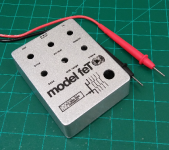
Hey, John from EAE here. About a month ago I heard a Model feT copy was in the works here. I hoped I could simply joke about it and move on, but I’m still feeling bothered. There isn’t really a playbook for how to handle this stuff.
I obviously don’t own the Model T design (just as Sunn didn’t own the 5F6) and I certainly wasn’t the first person to use JFETs in lieu of tubes. I’ve never claimed otherwise, in fact I directly credit Runoffgroove in the product manual. I think the calling card of the Model feT is the power amp emulation circuit. At the time I initially designed it (c. 2015-2016) I believed the approach to be novel, at least in a pedal context. I have since more accurately identified it as a case of convergent emulation (e.g. Intersound IVP, a couple things floating around DIY Stompboxes), so I’m not the only person who realized a transistor differential amplifier sounds good when overdriven. Now, I did start with the ROG approach in a sense, but their model does not do a good job of emulating 1) triode miller capacitance and 2) partial frequency bypass of a common cathode amplifier. So I gradually worked around these things through many hours of simulations and comparisons with the original Model T. That’s the whole story.
Anyway first, BOM errors: while the build doc isn’t up yet, the component list was posted in a separate thread that was brought to my attention. There are a few capacitor values that aren’t present on our BOM, hence my comment that the parts were inaccurate. If the discrepancies are what I think they are, and my back-of-the-envelope math checks out, the mofeta is going to sound significantly brighter than the Model feT. Worst case scenario it could be unstable at high gain, particularly with drive pedals stacked in front. Something to look out for should you build one.
Second, layout issues: applying high speed layout techniques to analog circuitry produces diminishing returns. But, at any speed, it’s good to keep high impedance nodes as short as possible, and you should keep sensitive amplifiers away from any clocks or SMPS/charge pump circuitry. JFET gates are extremely high impedance—so high that we have to specify an IPC-A-610 Class 3 cleaning step (read: maximally clean) on our boards because stray capacitance from excess flux can measurably change the frequency response.
So why did I call the mofeta layout bad? The component placement alone throws up serious red flags. The “preamp” JFETs are located all the way near the bottom, but their respective gain controls at the top. On top of that, the charge pump (IC100) is 1) close to the gain pots and 2) smack dab in the middle of both halves of the simulated phase inverter. I can’t see how this wouldn’t throw KHz switching spikes all over the place, or possibly heterodyne with other charge pumps and digital (FV1/BBD) clocks in your signal chain. I’ve debugged these issues for myself and others multiple times in the past. That kind of noise is a dealbreaker.
I’ve reverse engineered pedals before—old, forgotten treasures with no schematics to be found. Reverse engineering is a LOT of work. So I really have to wonder, why spend all that time copying in-production pedals when you could put that energy toward designing something new instead? I don’t get it.
Thanks for letting me speak my peace. If anybody wants to talk about this directly my email inbox is always open.


 www.instagram.com



 I do think I absorb the larger point though.


