
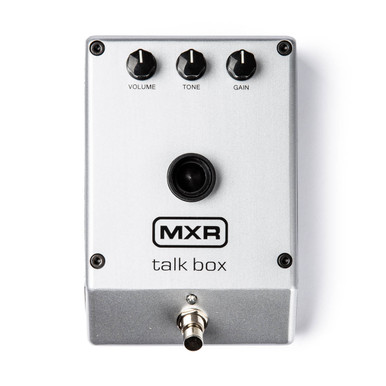
MXR Talk box

RetiredUnit1

Well-known member
But is it worth $200 for a one trick pony?
 
Are the talkbox and the vocoder the same thing?
So with a vocoder your sending a signal through a bunch of band-pass filters. With the talkbox, the tube has a speaker at the bottom and the sound goes into your mouth. Then you capture the sound coming out of your mouth with a microphone. Your guitar signal goes through your mouth!
 
Last edited:
So with a vocoder your sending a signal through a bunch of band-pass filters. With the talkbox, the tube has a speaker at the bottom and the sound goes into your mouth. The you capture the sound coming out of your mouth with a microphone. Your guitar signal goes through your mouth!
I always thought for the talkbox you sang into the tube and the speaker at the end of the tube picked up your voice like a microphone and used it to modulate your guitar signal. Mind blown.
 
Yeah the Cher song is Autotune. But the producers claimed at the time that it was a vocoder, because they were trying to keep their (at that time novel) non-standard ‘effect-y’ Autotune to themselves. Obviously that cat didn’t stay in the bag;)

To expand a little on vocoders, you have a “formant”: in the classic scenario, your voice into a mic, and a “carrier”: typically a synthesizer (some vocoders do have a built in oscillator), but could be any electronic instrument you care to plug in. The formant, via an envelope follower type circuit in the vocoder, opens the aforementioned bank of bandpass filters and the synth passes through them.

So the output of a vocoder is all synth/instrument. Your voice (aka dry signal) is just used to generate a control voltage to control the filters, and it’s not present at all in the audio output.

* some vocoders do have a knob to let you mix in some dry mic signal for ‘legibility’ purposes.
 
Last edited:
Yeah the Cher song is Autotune. But the producers claimed at the time that it was a vocoder, because they were trying to keep their (at that time novel) non-standard ‘effect-y’ Autotune to themselves. Obviously that cat didn’t stay in the bag;)

To expand a little on vocoders, you have a “formant”: in the classic scenario, your voice into a mic, and a “carrier”: typically a synthesizer (some vocoders do have a built in oscillator), but could be any electronic instrument you care to plug in. The formant, via an envelope follower type circuit in the vocoder, opens the aforementioned bank of bandpass filters and the synth passes through them.

So the output of a vocoder is all synth/instrument. Your voice (aka dry signal) is just used to generate a control voltage to control the filters, and it’s not present at all in the audio output.

* some vocoders do have a knob to let you mix in some dry mic signal for ‘legibility’ purposes.
I guess Kraftwerk were pioneers of the vocoder


According to wikipedia, they say that the musical application of a vocoder is actually a voder, using only the decoding half. But voder sounds weird.

 
Back
Top