
You are using an out of date browser. It may not display this or other websites correctly.
You should upgrade or use an alternative browser.
You should upgrade or use an alternative browser.
What's in the mailbox? 📬 📦
- Thread starter Harry Klippton
- Start date


Harry Klippton
Not Interested
I am finishing pedals glacially slow but have succeeded in not buying any moreNo @jimilee - someday I’m going to start finishing pedals faster than I buy new pcbs.

drgonzo1969
Well-known member
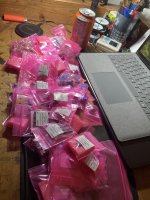
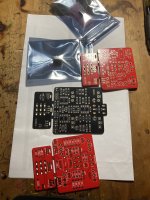
it's totally normal to hoard PCBs

Passinwind
Well-known member
I sometimes use appropriately sized drill bits in a pin vise to clear clogged holes. I buy 0.6mm ones ten at a time off eBay, since they are quite fragile. But with practice one can often just install two lead components without pre-clearing the hole. Board rework can definitely be frustrating, but as with any craft, building your chops can also be very satisfying.Every time I accidentally fill an empty hole I have to trash the board. No matter what I use, a good solder sucker, solder wick, even those hollow needles, nothing works and I end up destroying the pads. The same thing happened to my Low Tide board.
It's why I'm considering quitting.
Last edited:

Silver Blues
Well-known member
Another thing I've found works well for desoldering plated through-holes is to clamp the board vertically, then heat from one side of the pad and suck from the other - then you don't have to worry about positioning the tips of both tools optimally. It sounds stupid but it works.

Fama
Well-known member
I've tried doing that while pulling with pliers - which is a huge pain in the ass, coordination wise, since you can only really look at one side to see that you're doing it correctly. But a solder sucker would be easier for sure.Another thing I've found works well for desoldering plated through-holes is to clamp the board vertically, then heat from one side of the pad and suck from the other - then you don't have to worry about positioning the tips of both tools optimally. It sounds stupid but it works.
I used these while desoldering a resistor on the Low Tide https://vi.aliexpress.com/item/32338424637.html, and for the price they're amazing (well, what wouldn't be for that price?). The second one from the top with the hook was quite handy, since you can hook that around the resistor and you don't need to see if you're doing it correctly, since the hook stays attached. The other end of that one is nice for scraping off flux. I also used the straight one as a makeshift drill and/or poker to clear through-holes from solder, but I think that's probably a bit risky.

Feral Feline
Well-known member
I too am...
- glacially slow building
- hoarding PCBs faster than I build
- using fine drill-bits to unclog holes
- clamping boards vertically and prepositioning the solder sucker and then hit the other side with heat and BAM!...
- glacially slow building
- hoarding PCBs faster than I build
- using fine drill-bits to unclog holes
- clamping boards vertically and prepositioning the solder sucker and then hit the other side with heat and BAM!...

andare
Well-known member
I think my soldering technique is solid. I would say most of my troubles with wiring and mounting boil down to workpieces moving/not being accessible/having awkward shapes.Another thing I've found works well for desoldering plated through-holes is to clamp the board vertically, then heat from one side of the pad and suck from the other - then you don't have to worry about positioning the tips of both tools optimally. It sounds stupid but it works.
I don't know how to clamp a board vertically. With a vise? I still don't own one. I have third hands, quad hands, blue tack, tape, I have a comb-like wire stand for tinning wires, if a part moves while soldering I make sure to reflow it once it's secured, etc.
I know I would benefit greatly from pre-bonded wire if I could find it in Europe. I know the theory behind tinning wires, it just never works as intended and I end up with blobs or too thick wire that doesn't fit the (IMHO unnecessarily small) pads.
At the end of the day I'm kind of clumsy with these things. Only practice will make me better.
Feral Feline
Well-known member
RE clamping a board vertically:
I've used blue-tac, third-hand devices, a couple of books...
My amp Sifu used to have a bunch of scrap wood laying around with holes and saw-marks — I thought it was scrap, until...

In short, use whatever means necessary.
I've used blue-tac, third-hand devices, a couple of books...
My amp Sifu used to have a bunch of scrap wood laying around with holes and saw-marks — I thought it was scrap, until...
In short, use whatever means necessary.

szukalski
Well-known member
I use this stuff, I'm about 50m into it so far..I know I would benefit greatly from pre-bonded wire if I could find it in Europe. I know the theory behind tinning wires, it just never works as intended and I end up with blobs or too thick wire that doesn't fit the (IMHO unnecessarily small) pads.
Fama
Well-known member
I love this one https://www.musikding.de/PCB-holder, works well for me.I think my soldering technique is solid. I would say most of my troubles with wiring and mounting boil down to workpieces moving/not being accessible/having awkward shapes.
I don't know how to clamp a board vertically. With a vise? I still don't own one. I have third hands, quad hands, blue tack, tape, I have a comb-like wire stand for tinning wires, if a part moves while soldering I make sure to reflow it once it's secured, etc.
I know I would benefit greatly from pre-bonded wire if I could find it in Europe. I know the theory behind tinning wires, it just never works as intended and I end up with blobs or too thick wire that doesn't fit the (IMHO unnecessarily small) pads.
At the end of the day I'm kind of clumsy with these things. Only practice will make me better.
I also use solid core wire from Tayda exactly because I struggled too often with pre-tinning wire and getting the stranded wire through holes after tinning. Solid core wire (at least the one Tayda has) is pretty stiff, which means getting footswitches into their hole can be a struggle if you solder them out-of-the-box and have too long wires, but for me the tradeoff is well worth it.
andare
Well-known member
Thanks But that isn't pre-bonded, it has to be tinned, right?I use this stuff, I'm about 50m into it so far..
I use silicone already cause it doesn't burn.
andare
Well-known member
I've never used a PCB holder because the board floats and some components will move. I always stick it down on a piece of blue tack. But I see how it could be useful sometimes.I love this one https://www.musikding.de/PCB-holder, works well for me.
I also use solid core wire from Tayda exactly because I struggled too often with pre-tinning wire and getting the stranded wire through holes after tinning. Solid core wire (at least the one Tayda has) is pretty stiff, which means getting footswitches into their hole can be a struggle if you solder them out-of-the-box and have too long wires, but for me the tradeoff is well worth it.
As for solid core wire, I use it for jumpers under boards and for ground connections in my eyelet board builds. The possibility of it breaking freaks me out cause then I'll have to desolder...
Thanks for the suggestions!
Fama
Well-known member
I'm not sure what you mean by components moving, I always bend the legs/pins so that they stay put while the board is upside down, which can be a bit of a pain at times, but the components stay put while soldering. Or if you mean inputs/outputs and such, I do those with the PCB in the box, usually. I thought by "workpieces moving" you meant the PCB slides way, or something like that, but I think I misread your first comment - my bad!I've never used a PCB holder because the board floats and some components will move. I always stick it down on a piece of blue tack. But I see how it could be useful sometimes.
As for solid core wire, I use it for jumpers under boards and for ground connections in my eyelet board builds. The possibility of it breaking freaks me out cause then I'll have to desolder...
Thanks for the suggestions!
FWIW I've never had solid core wire break, I wasn't aware of that being a thing at all until I read it on one other thread on here. Something like resistor legs I could see breaking, but this stuff is so thick (well, not THAT thick, but thick enough) that I don't really see it breaking very easily.
szukalski
Well-known member
It’s pre tinned.Thanks But that isn't pre-bonded, it has to be tinned, right?
I use silicone already cause it doesn't burn.
andare
Well-known member
I also bend the legs but some components still move, electrolytic caps for example, and sockets have short legs so they have to be held by tape of pressure.I'm not sure what you mean by components moving, I always bend the legs/pins so that they stay put while the board is upside down, which can be a bit of a pain at times, but the components stay put while soldering. Or if you mean inputs/outputs and such, I do those with the PCB in the box, usually. I thought by "workpieces moving" you meant the PCB slides way, or something like that, but I think I misread your first comment - my bad!
FWIW I've never had solid core wire break, I wasn't aware of that being a thing at all until I read it on one other thread on here. Something like resistor legs I could see breaking, but this stuff is so thick (well, not THAT thick, but thick enough) that I don't really see it breaking very easily.
By workpiece I mean PCBs but also switches and pots, things that I have to get creative to cinch down.
I'm a bad combination of clumsy and perfectionist

drgonzo1969
Well-known member
drgonzo1969
Well-known member

dawson
Well-known member
I like that wood block @Feral Feline!
It reminds me of a similar 'holding' technique I've been using for a few months:
Pliers + elastic hair tie or rubber band
 replaced an obliterated footswitch on my friends' EHX Grand Canyon. Apparently, his son's guitar maliciously tore down a poorly installed wall hanger and attacked a pedalboard.
It reminds me of a similar 'holding' technique I've been using for a few months:
Pliers + elastic hair tie or rubber band
 replaced an obliterated footswitch on my friends' EHX Grand Canyon. Apparently, his son's guitar maliciously tore down a poorly installed wall hanger and attacked a pedalboard.


