when to use mlcc capacitors

I see microphonic ceramic disc (single-layer) caps all the time, but I've literally never seen/heard a microphonic MLCC.
I haven't either but I was under the impression that the higher the value the more microphonic and by the time we get to higher values that may be more microphonic we use film, so that's typically why it's a non-issue
 
I haven't either but I was under the impression that the higher the value the more microphonic and by the time we get to higher values that may be more microphonic we use film, so that's typically why it's a non-issue
I have several production designs with 2.2uF MLCC in the signal path, never had microphonics. It's anecdotal evidence, but there were literally 700 such units in 2025 alone, so I feel like it's a pretty good anecdote.

I will caveat that I use X7R or better dielectric mlcc for stability over temperature/voltage.
 
Last edited:
I have several production designs with 2.2uF MLCC in the signal path, never had microphonics. It's anecdotal evidence, but there were literally 700 such units in 2025 alone, so I feel like it's a pretty good anecdote.

I will caveat that I use X7R or better dielectric mlcc for stability over temperature/voltage.
Just curious if those were smd or thru hole?
 
Last edited:
I see microphonic ceramic disc (single-layer) caps all the time, but I've literally never seen/heard a microphonic MLCC.
I have, once. But the pedal was on the floor 3-4 feet in front of a cranked bass amp. It would ring on loud notes. Almost like a volume dependant oscilation.
It messed with em for a bit until the chopstick test proved the culprit.
Edit to add, this was definitely a 2 cent tayda or Ali cap.
 
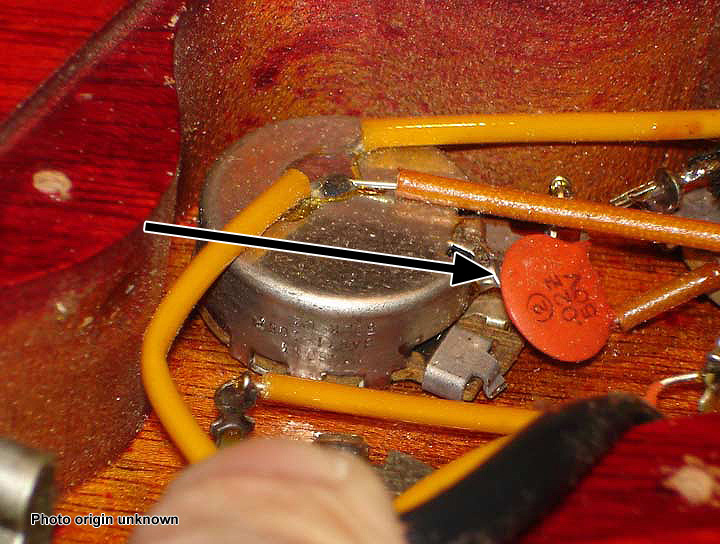
I love seeing old Fender and Gibson guitars that have a big ceramic capacitor for the tone control. I think of this kind of discussion every time.

ceramic_disc_cap_wm.jpg


NOS High Voltage Ceramic... "excellent sounding"

It may be that the limitations of the ceramic cap (noisy, etc) are mostly found in higher frequency applications and don't have as much, if any, effect at the lower freqs our circuits deal with.
Or even there’s the possibility the not-so-good specs actually sound better …

There’s a few threads on forums in bass land where people have tried to trace and clone the Wal bass filter preamp - and EVERY SINGLE TIME I’ve seen it the person goes “oh wow the IC used is prehistoric we’ll have to upgrade that”
And every single time “oh it doesn’t quite sound like the original” - and I am def not a electrical engineer, and couldnt redesign it better but my designer logic thinks it’s almost as if the crazily slow slew rate might possibly be part of the reason the thing sounds like it does…
 
What’s the deal with Tantalum again? Use them when the circuit calls for additional human suffering?
Yes, but only vintage tantalums are acceptable. That way, the flavor of the pain has had time to age into a distinct vintage.

NP0/C0G are the same thing. NP0 =Negative-Positive Zero Temperature Coefficient (meaning, capacitance does not change with temperature), C0G is simply the EIA three-letter code for an NP0 dielectric:


ppm/°C
Multiplier​
Tolerance in ppm/°C (25-85 °C)
C: 0.00: -1G: ±30
B: 0.31: -10H: ±60
L: 0.82: -100J: ±120
A: 0.93: -1000K: ±250
M: 1.04: +1L: ±500
P: 1.56: +10M: ±1000
R: 2.27: +100N: ±2500
S: 3.38: +1000
T: 4.7
V: 5.6
U: 7.5


C0G's are *quite* good. In fact, if given the choice between a C0G and a Polyester film capacitor, I'm typically choosing a C0G. They're on par with polypropylene film when it comes to distortion (polypro tends to win by a hair), are better for circumstances requiring precision due to their very low temperature coefficient, and fare only a little worse when it comes to dielectric absorption.

Granted...cost per unit might be a factor. Depending on the value, polyester may be cheaper, and you probably won't notice much of a difference in most applications. C0G can be had up to about 220nF as far as I've seen in a leaded package, though they'll be a little larger than polyester in the larger capacitance ranges.

TL:DR: There's no reason not to use C0G aside from cost and size. They're fantastic. X7R's are the next commonly available step down in MLCC's and are usable in many positions, but polyester is generally the better choice for everything except decoupling.

Now...how much will this impact your builds? Probably not much. Changing one cap ain't gonna make the difference between god-like toan and poo. Though I'm a fan of using stupid overbuilds in pedals because I'm apparently Mr. Moneybags and like to spend more than I absolutely need to, cause my parents didn't love me enough.

 
Ethically sourced human suffering when it's your own?
That's right—no kink shaming here!

The problem is, all the people who are smart enough to know and in a position to care aren't building or thinking about low power low frequency (audio) circuits. There are a lot of things that matter when you are doing high power or high frequency (digital) stuff that just aren't practical concerns for us. If you're an EE building fighter jet computers, you know when to use MLCCs and when not to. If you're a pleb building guitar pedals, "caps is caps."
 
If you're a pleb building guitar pedals, "caps is caps."
I assume it might also be (at east partially) a case of the effect being very small amounts of audible distortion you can maybe hear in pristine conditions on good monitors, trained ears, and only listening to this signal, for example.

...and the pedal is a fuzz. So nobody can really say if it makes a difference, and whether it would be good or bad if there is a difference.
 
Back
Top